This is Julian's seventh year studying these tiny hummingbirds in the rain forest of Trinidad, recording their mating songs and dances, collecting data about these little known and shy birds by watching them, banding them and trying to trace paternity. The Little Hermits live in leks, one lek for their life, and males display for the females by dancing and singing their hearts out in an effort to be chosen by a female for mating. Each lek has its own song and, if a male moves to another lek for some reason, he learns the song of the new lek. Imagine. No one knew this before. As for what more this research will teach us about these hummingbirds, birds in general or the world around us remains to be seen but already it has increased the sense of awe in those who talk to Julian, including me and my grandson pictured below helping make the bands for the hummingbirds. Perhaps it's enough.
var ccOptions = {
align: 'right'
};
function _initCulturalCreatives() {
var script = document.createElement('script');
script.setAttribute('type', 'text/javascript');
script.setAttribute('src', ("https:" == document.location.protocol ? "https://" : "http://") + "culturalcreatives.cc/assets/js/widget-min.js");
document.getElementsByTagName('head')[0].appendChild(script);
}
_loadMod = window.onload;
window.onload = (typeof window.onload != 'function') ? _initCulturalCreatives : function() { _loadMod(); _initCulturalCreatives(); };
Showing posts with label environment. Show all posts
29 January 2013
In Praise of Research and Researchers
See those tic tac sized eggs in the incubator? They're Little Hermit Hummingbird eggs and the first photo is one of them candled; the slight red patch is the three day old heart of this soon-to-be hummingbird which I saw beating. The next photo shows the scale to weigh them and the data on the two latest eggs. Two "dummy" eggs replace them in the thimble sized nest so the mother continues to sit on them. Once hatched in 16 days, they will be placed back in the nest and mother will feed them insects and nectar multiple times a day to grow them from a shriveled raisin sized hatchling to a full sized hummingbird in 17 days. It must be fast because they're so vulnerable to predation in their nest close to the ground and attached to the back of a fern frond. They're in the incubator to begin with because they're even more vulnerable as eggs and because Julian, the researcher who lives in a house on my daughters property for four months a year, will swab the inside of the hatched egg for DNA for his research.
This is Julian's seventh year studying these tiny hummingbirds in the rain forest of Trinidad, recording their mating songs and dances, collecting data about these little known and shy birds by watching them, banding them and trying to trace paternity. The Little Hermits live in leks, one lek for their life, and males display for the females by dancing and singing their hearts out in an effort to be chosen by a female for mating. Each lek has its own song and, if a male moves to another lek for some reason, he learns the song of the new lek. Imagine. No one knew this before. As for what more this research will teach us about these hummingbirds, birds in general or the world around us remains to be seen but already it has increased the sense of awe in those who talk to Julian, including me and my grandson pictured below helping make the bands for the hummingbirds. Perhaps it's enough.
05 November 2012
Combing Olive Trees Branch by Branch
Fall brings a favorite opportunity in our olive rich area - harvesting olives the old fashioned way by combing branch after branch of our friend's olive trees. She has few enough trees to do it this way rather than the more mechanized version used by larger places. What a wonderful way to spend a day with friends.
My friend Sheila's trees were laden this year, ready to be swept into the nets below. Yesterday was in the high 60's with intermittent sun, the three dogs were bounding around begging someone to throw a stick for them to fetch and six of us were eager to engage in the ancient, almost meditative practice of harvesting olives.
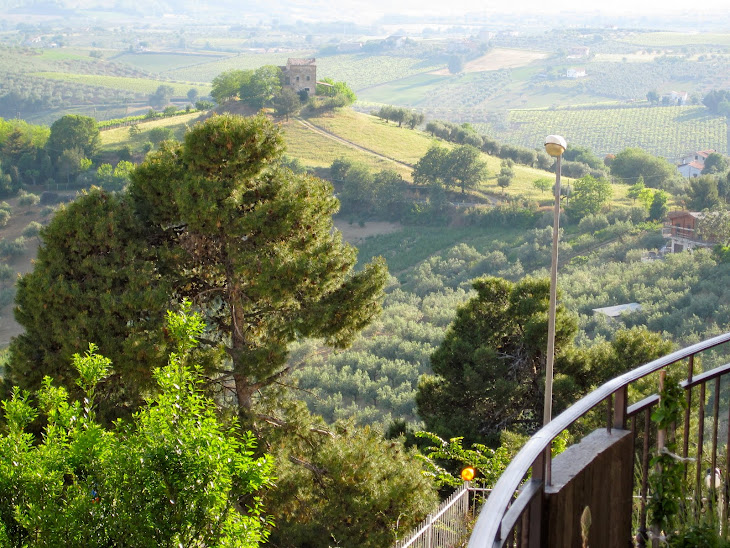
A view from the olive grove located about 40 minutes from my house and closer to the mountains.
Sheila prepared a delicious, home cooked feast for the workers. We ate, chatted and shared snippets of our lives in Italy, rich with new-for-us experiences that endear us to this land, this place.
After pressing, each couple's reward is five liters of olive oil. I'm sure it enhances the heart benefits of olive oil to have combed the trees branch by branch and harvested the olives with our own hands.
Sheila has a couple of trees with eating olives rather than those meant to be crushed for oil. The green olives from Abruzzo, our area of Italy, are scrumptious and rated highly nationally.
Olive oil is used in products as well. Soap, of course, but also shampoo, body wash and lotion. My skin and hair love them.
It's hard to overestimate the value of slow, simple, earth based activities further connecting me to all that is- the trees, the sun, the earth, fresh air, fresh food, friends, easy banter, play with a dog, being a part of the cycle of that which feeds me. I'm grateful.
26 September 2012
County Clare, Ireland Photos
Found while hill walking:
At a garden center, these made me laugh:
Irish sunset over the sea bid us a fond farewell:
31 August 2012
Tundra
The very name chosen for me speaks
to my strength, tundra. Sounds
strong, like lichen, Don't
tell of my fragility,
they'll banish me you know.
Each step on my surface means
habitat lost, mosses crushed. When so
little lives, each is essential, precious. Not
in some darling sense but bedrock
real, life based now on what others
do unto me, outside
my control, while winds howl.
This is based on a prompt form Imaginary Gardens With Real Toads on Transforming Fridays Take Two- Tundra with the challenge to speak in the voice of the flora or fauna of the tundra, or as the tundra herself. (Photo from Hannes Grobe at Wikimedia Commons.)
22 August 2012
Summer Heat
Plants line my balcony parched
in the unrelenting summer heat.
Even with daily sacks of water, leaves
tip brown, flowers fall, unable
to hold. My neighbors say their herbs die.
Against all this my basil thickens, greens
and lushes, reaches to that scorching sun
and grows heedless of what withers others.
My neighbors come to beg basil. They want
what that plant offers, want to eat it, add it
to their food, feed it to their children,
watch it lurch up as most succumb. They tell
friends and friends seek some. The more its shared
the more it grows. Basil takes that blazing
sun, paints yellow on its green leaves, sports it
like a scout's survival badge and just keeps growing.
This is posted as part of Open Link Night over at dVerse Poets Pub hosted today by Natasha Head. It's a talented group, decidedly diverse, who love poetry so check it out.
03 March 2012
Mountain Snow and Blooming Dogwoods
Labels:
Abruzzo,
environment,
home,
scenery,
spring
07 September 2011
Convergent Evolution
I thought I was looking at a tiny hummingbird with his long proboscis in our red geranium. (Look where yellow and orange meet about a third of the way down the photo.) I've seen hummingbirds as small as this in Trinidad's Rain Forest. The smallest of the hummingbirds, the Bee Hummingbird, lives there and measures just 5cm. But my neighbor's daughter told me that Italy has no hummingbirds and that instead it was a hummingbird hawk-moth. Who knew there was such a thing?
(image from Wikipedia)
Wikipedia said that the Hummingbird Hawk-moths that are loving my plants are a good example of convergent evolution. Right on my balcony! Ever a sucker for new facts, I skipped to the info about convergent evolution and found that it "describes the acquisition of the same biological trait in unrelated lineages." They cited the example of an owl and a cat which are "distantly related predators that share keen, night-time binocular vision and targetable ears to help their night time hunting."
(both images from Wikipedia)
But back to the Hummingbird Hawk-moths and the hummingbirds. My tiny visitor is distinguished among moths for his rapid, sustained flying ability. In fact he is one of the fastest flying insects clocking in at 50km/h or 30m/h. He and his species hover in midair while they feed on nectar from flowers. Like hummingbirds, they are specialized nectarivores. Imagine!
Anyway, their hovering capability has evolved only three times in nectar feeders: in hummingbirds, certain bats and hawk moths (family: sphingidae). The hummingbird hawk-moth's hovering is similar to, but distinct from, that of hummingbirds. Both have long and mostly straight bills for their specialized nectar feeding and drink it with their trough-like tongues.
It seems the plants that are pollinated by hummingbirds or hummingbird hawk-moths produce flowers in shades of red, orange and bright pink. My geranium is an almost neon orangey-red so that's evidently why I'm seeing so many of these hawk-moths. It's okay with me, nature is an awesome teacher!
20 June 2011
02 June 2011
Locally Grown - Making a Difference
"If every U.S. citizen ate just one meal a week composed of locally and organically raised meats and produce, we would reduce our country’s oil consumption by over 1.1 million barrels of oil every week. Small changes in buying habits can make big differences. Becoming a less energy-dependent nation may just need to start with a good breakfast.”
— Steven L. Hopf in Animal, Vegetable, Miracle by Barbara Kingsolver
I highly recommend this wonderful book by one of my favorite authors. Kingsolver's husband and daughter also contribute chapters on this internationally important topic.
I'm headed to Ireland tomorrow for a week and may not have access to computers while there. If I don't, I'll catch you later!
— Steven L. Hopf in Animal, Vegetable, Miracle by Barbara Kingsolver
I highly recommend this wonderful book by one of my favorite authors. Kingsolver's husband and daughter also contribute chapters on this internationally important topic.
I'm headed to Ireland tomorrow for a week and may not have access to computers while there. If I don't, I'll catch you later!
04 February 2011
Rain Forest Flowers
Here are just a few of the flowers I've met along the way in Trinidad, some on hikes in the rain forest, some in my daughter's yard and some in a friend's garden (thank you Bunty and Rory).
It's a beautiful time of year in the Caribbean.
Please enjoy...
Croton
Another color of Croton
Clerodendron:
Butterfly lilly:
French kiss:
Locally known as the Snake plant:
Red ginger:
Oxalis:
Agouma:
No one knew the name for this:
Costus sp., known locally as the penis plant:
Chaconia, Trinidad's national flower:
Poinsettia:
Heliconia; known locally as Sexy pink:
Aphelandra sinclairiana:
Angel's trumpet:
Orchid (they grow wild all through the rain forest):
Anthurium:
Ixora:
Crown of thorns:
Hibiscus:
Having my camera always with me this trip has kept my eyes open in a new way to this environment.
It's been a visual feast for me. What's catching your eye these days?
Subscribe to:
Posts (Atom)


